

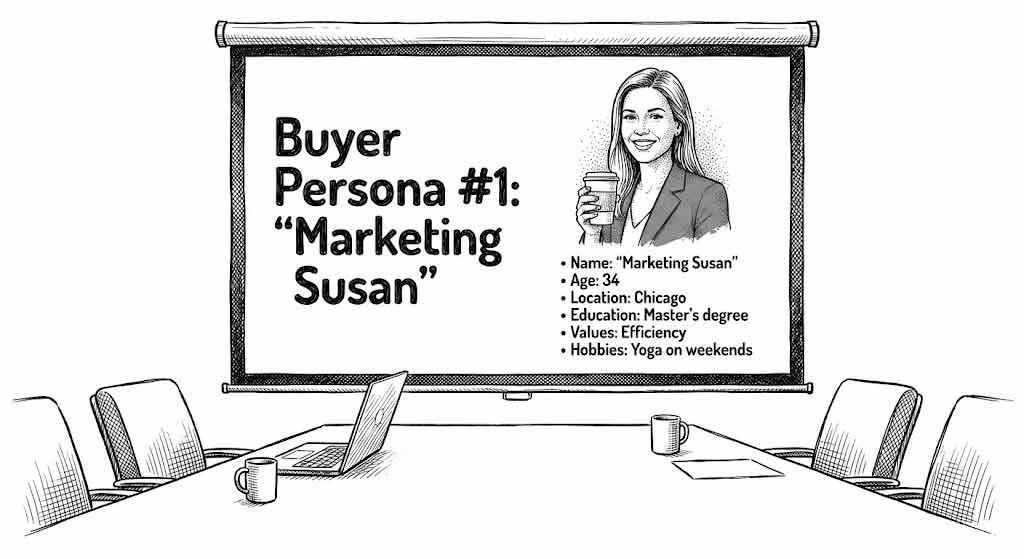
There is a slide in almost every marketing deck that kills creativity. It usually features a stock photo of a smiling woman in a blazer holding a coffee cup. Her name is “Marketing Susan.”
Underneath her photo, bullet points list her attributes: She is 34. She lives in Chicago. She has a Master’s degree. She values efficiency. She likes yoga on weekends. This is known as a “buyer persona”. A buyer persona is a kind of “cheat sheet” that describes a person you are selling to. It usually contains demographic data, job title, what they value, and possibly a short bio.
The problem isn’t that this information is wrong. The problem is that for a writer trying to craft a compelling argument or website copy, this information is useless.
Knowing that Susan lives in Chicago doesn’t help you write a headline that stops her scroll. Knowing she “values efficiency” doesn’t help you understand why she hesitated to click “Buy” on your pricing page last Tuesday.
Most buyer personas fail because they are treated as biographies when they should be psychological maps.
Starting with Demographics
We default to demographics (age, location, job title) because they are easy to categorize and safe to present in a boardroom. They feel scientific.
Demographics are for media buying… telling an ad platform who to target. They are rarely useful telling a writer what to say. When you write for a demographic, you end up with “vanilla copy”—polite, professional, and entirely forgettable. You are writing for a category, not a human.
We have to stop mapping attributes and start mapping friction.
Mapping the Friction
A useful persona also describes what stands in their way. When a professional looks for a solution (software, consulting, a new agency), they are not just looking for “features.” They are trying to navigate their own anxieties and constraints.
If you want a persona that actually helps you write, here are two types of friction you can include:
1. External Friction (The Logistics). These are the tangible barriers your buyer faces in their daily work.
- The Budget Committee: Do they have to justify this purchase to a CFO who hates spending money?
- The Legacy Stack: Are they trying to integrate your modern tool with a dinosaur system that hasn’t been updated since 2015?
- The Time Deficit: Do they actually have time to learn a new workflow, or are they drowning in meetings?
2. Internal Friction (The Psychology). This is where the real writing insights live. This is the “3 AM” stuff.
- Imposter Syndrome: Are they a new manager afraid of making a bad decision that exposes their inexperience?
- Decision Fatigue: Are they overwhelmed by 50 nearly identical options and looking for someone to just simplify the choice?
- Status Anxiety: Will buying your product make them look like an innovator to their peers, or a risk-taker who wasted company resources?
When you understand that “Susan” isn’t just a “34-year-old Project Manager,” but a professional who is terrified of migrating data and losing a week of production, your writing changes. You stop writing about “robust features” and start writing about “seamless, risk-free migration.”
The “Skeptic” Persona
There is a tendency in brainstorming sessions to idealize the buyer. We imagine the “Perfect Customer”—someone who immediately understands our value proposition, nods along with our jargon, and has their credit card ready.
This is dangerous because the Perfect Customer doesn’t need to be persuaded. They already agree with you. If you want to sharpen your thinking, draft a Skeptic Persona.
- Why do they think your solution is overpriced?
- What past experience burned them on a product like yours?
- Why do they think they can just “do it themselves in Excel”?
Writing for the Skeptic forces you to clarify your thinking. It forces you to strip away the fluff and address the elephant in the room. If your arguments can convince the Skeptic, they will easily convince the Believer.
Where Do You Find the Friction?
If you sit at a desk and “brainstorm” a persona, you will inevitably create a fictional character who perfectly loves your product. You will write Fan Fiction, not strategy. You cannot “make up” friction. You have to excavate it.
Here is how toget this data without guessing.
1. Digital Eavesdropping
People lie in surveys because they want to be polite. They tell the truth when they are anonymous.
- Where to go: Reddit, niche Slack communities, Quora, and Twitter.
- What to search: Don’t search for “solutions.” Search for complaints. Look for phrases like: “How do you guys handle…”, “I hate it when…”, or “Is it just me, or is [process] a nightmare?”
- The Insight: If you see 50 developers complaining that security tools slow down their build time, you didn’t “make up” the Interrupted Architect persona. You found her screaming into the void.
2. The “3-Star Review” Goldmine
Go to G2, Capterra, or Amazon and look at the reviews for your competitors.
- Ignore the 5-star reviews (usually fake or incentivized).
- Ignore the 1-star reviews (usually irrational anger).
- Read the 3-star reviews. These are rational people who wanted to like the product but hit friction.
- What to look for: “I loved the features, but the reporting was so complex I gave up.” -> Insight: The buyer is intimidated by complexity.
3. Sales Call Autopsy
Your sales team (or your own memory) holds the answers. Don’t just ask why people bought. Ask why they didn’t buy.
- Go through the last 10 deals you (or your top salesperson) lost.
- The Friction: Did they say “It’s too expensive”? (Price friction). Did they say “I can’t get IT to approve this”? (Bureaucratic friction). Did they just ghost you? (Overwhelmed friction).
- The Trigger: Look at the emails before the demo. What specific disaster happened that made them book the call? That is their trigger.
If you cannot point to a real forum post, a real sales email, or a real review that validates a specific fear, do not put it in the persona. Keep searching until you find the evidence.
You rarely get this data in a neat package. Real insights are scattered across sales call recordings, customer support tickets, angry Reddit threads, and casual coffee chats. It is messy work. It requires reading between the lines of what a customer says versus what they do.
Here are three examples.
Example 1: The Enterprise SaaS
The Company: TeamSync is a project management platform designed for large, remote-first organizations.
The Promise: “Centralize your workflows.”
The Weak Persona: “Manager Mike”
- Demographics: Male, 38-45, Director of Operations.
- Location: Coastal hubs (SF, NY, Austin).
- Education: MBA preferred.
- Interests: Productivity hacks, cycling, reading tech news.
- Goals: Wants to increase team efficiency and hit quarterly KPIs.
- Pain Points: Disorganized files, missed deadlines.
Why this fails:
It describes a job title, not a human problem. “Wants to increase efficiency” is true of literally every manager on earth. This persona leads to generic copy like: “Boost efficiency with TeamSync!” which Mike will ignore because he has seen it 50 times today.
The Useful Persona: “The Blindfolded Director”
- The Core Tension: He is responsible for output, but he currently feels like he has zero visibility into what his team is actually doing all day. He is terrified of being asked “What’s the status of Project X?” by the CEO and not having an answer.
- The “3 AM” Worry: “If we miss the Q3 launch because of a communication breakdown, it’s my head on the chopping block.”
- Internal Friction: He hates nagging his team for updates because he doesn’t want to be a micromanager, but the silence makes him anxious.
- Buying Trigger: He isn’t buying “organization.” He is buying automated visibility. He wants a dashboard he can check silently so he feels in control without annoying his staff.
- Skepticism: “Is this just another tool my team will refuse to use? I can’t afford another failed implementation.”
Marketing implication: Instead of writing “Organize your files,” you write: “Stop nagging your team for updates. Get real-time visibility without the status meetings.”
Example 2: The Technical Product
The Company: CodeGuard is an automated security testing tool for software development teams.
The Promise: “Find bugs before you deploy.”
The Weak Persona: “Developer Dave”
- Demographics: Male, 24-35, Senior Software Engineer.
- Income: $120k+.
- Traits: Introverted, logical, loves gaming and Reddit.
- Goals: Wants to write clean code and ship features fast.
- Pain Points: Bugs in production, manual testing is boring.
Why this fails:
This is a caricature of a “nerd.” It relies on stereotypes (gaming/Reddit) that have nothing to do with buying decisions. It assumes he wants to buy security tools. He doesn’t; he wants to code.
The Useful Persona: “The Interrupted Architect”
- The Core Tension: She wants to be building cool new features, but she spends 40% of her week fixing security patches from messy code junior devs wrote.
- The “3 AM” Worry: “I’m going to get paged at 2 AM on Saturday because a vulnerability slipped through.”
- Internal Friction: She views security tools as “bloatware” that slows down her CI/CD pipeline. She trusts her own code more than a tool.
- Buying Trigger: She isn’t buying “security.” She is buying her time back. She wants a tool that quietly handles the grunt work so she can get back to “real engineering.”
- Skepticism: “This tool is going to generate 100 false positives and waste even more of my time.”
Marketing implication: Instead of writing “Bank-grade security for your app,” you write: “The security suite that doesn’t slow down your build time. Stop fixing patches on weekends.”
Example 3: High-Ticket Service
The Company: Apex Leadership is an executive coaching for founders scaling past $10M revenue.
The Promise: “Scale your leadership skills.”
Weak Persona: “Founder Felicia”
- Demographics: Female, 35-50, CEO/Founder.
- Net Worth: High.
- Lifestyle: Travels often, values self-improvement, reads HBR.
- Goals: Wants to grow the company to $50M. Wants to be a thought leader.
- Pain Points: Scaling challenges, hiring executives.
Why this fails:
It focuses on the success: The travel, the net worth, the growth. But successful people actually hire coaches because they are suffering in a way they can’t admit publicly.
Useful Persona: “The Imposter at the Top”
- The Core Tension: The company has outgrown her original skill set. She used to know everyone’s name; now she sees strangers in the hallway and feels like she’s losing the culture.
- The “3 AM” Worry: “Everyone looks to me for the answer, but I’m just guessing. Eventually, they are going to realize I’m making this up as I go.”
- Internal Friction: She has no peers. She can’t complain to her employees (bad for morale) and she can’t complain to her board (makes her look weak). She is profoundly lonely.
- Buying Trigger: She isn’t buying “growth strategies.” She is buying a safe space to be vulnerable. She needs a confidant who won’t judge her for not knowing the answer.
- Skepticism: “Is this just another ‘guru’ giving generic advice who has never actually run a business this size?”
Marketing implication: Instead of writing “Take your business to the next level,” you write: “It’s lonely at the top. Get an advisor who has navigated the $10M to $50M chaos before.”
Ask yourself: “What is this person afraid of getting wrong today?”